
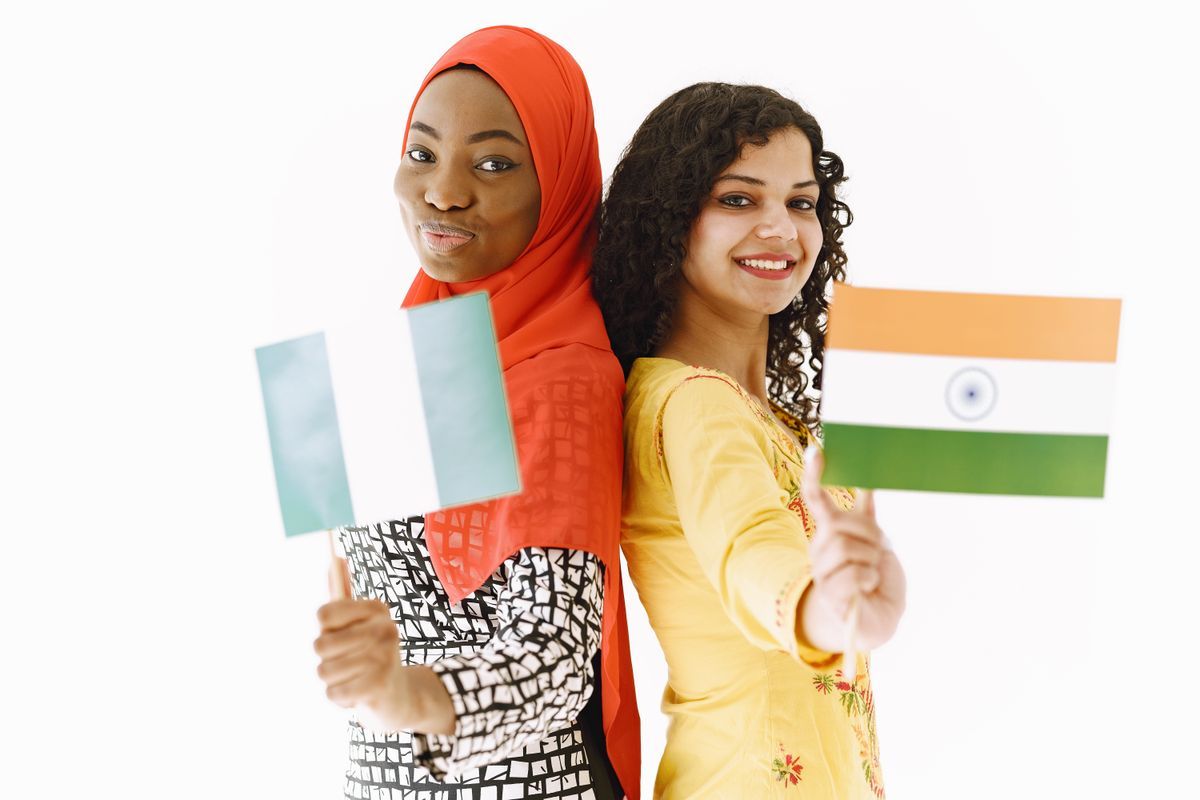
How to Connect With People From Different Cultures in Real Life
You live in the most international city on earth and your group chat is culturally identical to you. Here's why that happens, and how to actually fix it.
FirstMove Team
17 June 2026 · 6 min read
Right now, somewhere within a mile of you, a kitchen is celebrating a goal in a language you don't speak. London is home to people from virtually every nation on earth, and this month the World Cup has turned that fact up to full volume. Forty-eight national anthems, one city.
And yet, look at your last ten WhatsApp threads. For most of us, the people we actually talk to look, sound and grew up suspiciously like we did. That isn't a character flaw. It is a default setting. But defaults can be changed, and the people who change this one consistently describe it as the best upgrade their social life ever got.
Why do we default to people just like us?
Sociologists call it homophily: the well-documented tendency to form ties with people similar to ourselves. It is not usually prejudice. It is friction. Shared references make conversation cheap. You laugh at the same childhood TV shows, you already know the etiquette, you never have to explain the joke.
Cross-cultural connection carries a small upfront cost: the moment of not knowing the reference, the fear of saying the wrong thing, the extra beat of effort. So given a room of strangers, we drift toward the lowest-friction faces and call it chemistry.
The cost of that drift is real. A culturally identical circle means every recommendation, opinion and worldview you encounter has already been filtered through your own background. The room agrees with you because the room is you.
What actually builds connection across cultures?
Decades of social psychology point to the same answer, and it is not "learn about other cultures" in the abstract. Connection across difference is built by doing something side by side. Researchers call this working toward shared goals on equal footing; in practice it means the friendship forms around a third thing that belongs to neither of you alone.
The third thing can be almost anything:
- Football. The most successful shared language ever invented. Nobody at a World Cup screening asks where you're really from. They ask if you saw that pass.
- Food. Every culture wants to feed you, and every culture is delighted when you genuinely want to be fed. A market stall queue is an introduction service.
- Music and dance floors. Rhythm needs no translation, and a dance class pairs you with strangers by design.
- Sport, climbing, running clubs. Shared effort compresses years of acquaintance into weeks.
Notice what's missing from that list: dinner-party conversations about cultural differences. Difference is a terrible starting point and a wonderful third date. Start with the shared thing; the backgrounds surface naturally once trust exists.
The questions that open doors (and the ones that close them)
The fastest way to kill a cross-cultural conversation is to make someone an ambassador for an entire nation. "What do your people think about X" turns a person into a spokesperson.
The questions that work are specific and curious:
- "What's the dish from home you can't find a good version of here?"
- "What did everyone watch growing up?"
- "Teach me the thing everyone gets wrong about your city."
The pattern underneath all three: you are asking about their life, not their category. And the "teach me" frame does quiet magic, because it puts the other person in the expert's chair and you in the student's. People remember the stranger who let them be the expert.
One more rule: you will get something wrong. A name, a custom, an assumption. The repair matters more than the mistake. "Sorry, tell me how to say it properly" earns more trust than never risking the conversation at all.
Where do you actually meet people from different cultures?
If your weekly routine only routes you past people like you, no mindset shift will help. The circle changes when the rooms change:
- This summer, the viewing centres. Watch Senegal in a Senegalese pub, Argentina in an Argentine one. You will never be welcomed harder than as the visitor who showed up for someone else's team.
- Language exchanges. Half the room wants to practise English. You are the product. Walk in and you're instantly valuable.
- Food markets and supper clubs. Structured enough to remove awkwardness, social enough to start conversations.
- Interest-first communities. Climbing walls, five-a-side leagues, photography walks. Anywhere the activity, not the demographic, picks the room. We've covered how shared interests do the heavy lifting in adult friendship generally; across cultures they do all of it.
The approach is the hard part. So we removed it.
Every suggestion above still ends at the same cliff edge: walking up to a stranger, across a cultural gap, with no idea whether they want to talk. That fear is the single biggest reason multicultural rooms stay socially segregated.
FirstMove exists to remove exactly that cliff. At a venue running a VibeZone, a geofenced layer that only switches on while you're physically inside, you can see who in the room has opted in to meeting people. The 3-Way Handshake makes the introduction mutual before a word is spoken: you Knock, they Challenge to confirm interest, you Connect. Nobody gets approached who didn't ask to be, which matters even more when neither of you can read the other's social cues by instinct.
And because everyone is on an Ephemeral Profile that vanishes after the event, the stakes drop to nearly zero. If the conversation doesn't land, it evaporates. If it does, you exchange real details the old way: out loud, in person. The full mechanics are here: how FirstMove works.
Key takeaways
- Culturally uniform friendship groups come from homophily, the default human drift toward low-friction similarity, not from deliberate choice.
- Connection across cultures is built side by side, around a shared third thing (football, food, music, sport), not through abstract conversations about difference.
- Ask specific, personal questions and use the "teach me" frame. Never make one person the ambassador for a whole culture.
- Change the rooms you're in and the circle follows: diaspora viewing centres, language exchanges, markets, interest-first clubs.
- FirstMove's VibeZone and 3-Way Handshake remove the cold approach, the part of cross-cultural connection that fear kills first.
What to do next
There are 48 nations playing football in this city's pubs for the next five weeks, and every one of them has a table with room on it. Download FirstMove and open the VibeZone wherever you watch: get the app.
Want more on building a real social life, not a contact list? Subscribe to the FirstMove newsletter.