
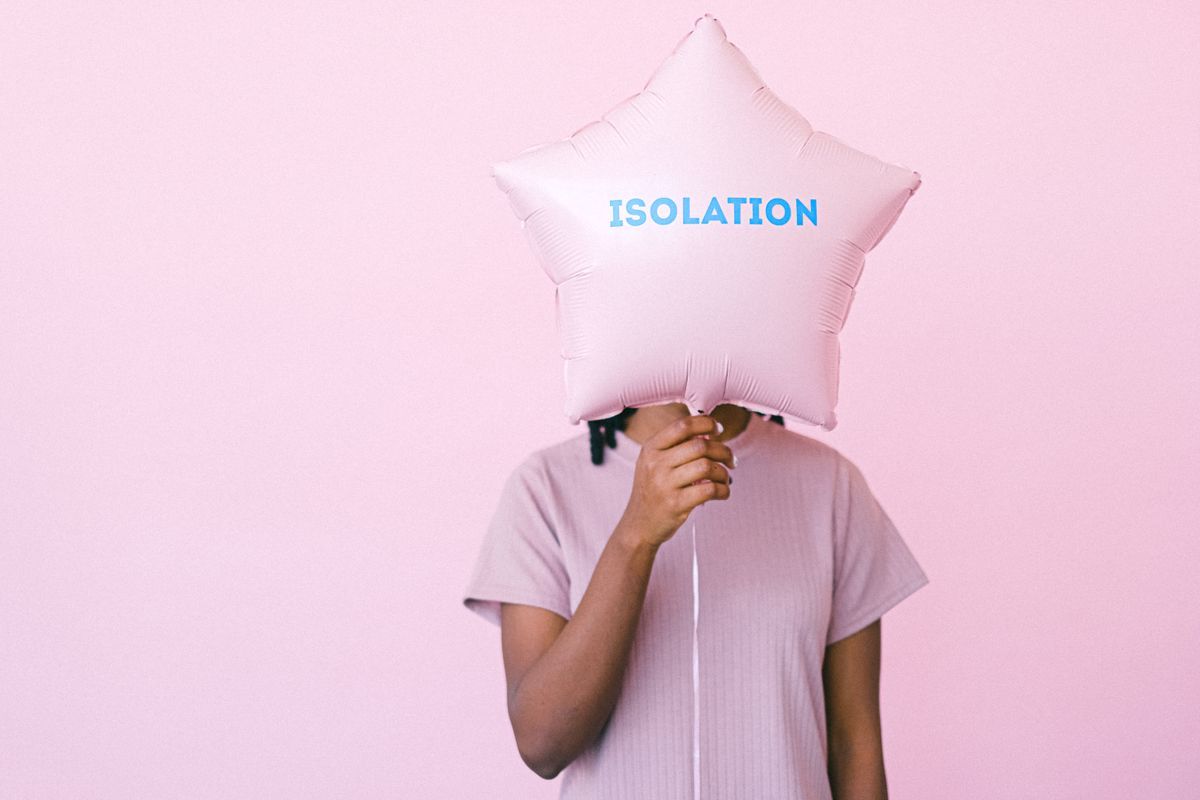
Social Isolation vs Loneliness: They're Not the Same Thing
You can be surrounded by people and profoundly lonely. You can be alone and feel entirely at peace. The distinction matters more than most people realise.
FirstMove Team
27 October 2025 · 7 min read
A common assumption in discussions of loneliness is that it's primarily about the number of people in your life. Lonely people are imagined as spending Friday nights alone, living in empty flats, having few social contacts. Fix the isolation, the thinking goes, and you fix the loneliness.
This conflates two distinct phenomena that research has carefully separated. Social isolation is objective: the measurable absence of social contact, relationships, and community participation. Loneliness is subjective: the distressing gap between the social connection you have and the social connection you want. They overlap but they're not the same, in the same way that being alone is not the same as being lonely, and confusing them leads to both bad analysis and bad interventions.
The Lonely Person in a Crowd
The most vivid illustration of the distinction is the person who feels lonely even when they're around people — at a party, in a busy office, in a city of millions — and experiences profound loneliness. Their loneliness is not a function of objective isolation. It's a function of the perceived quality of their connections: the feeling that they are not genuinely known, that no one would really notice their absence, that their interactions are performative rather than real.
Research by John Cacioppo, who spent decades studying loneliness at the University of Chicago, consistently found that lonely people and non-lonely people often have similar numbers of social contacts. What differs is how those contacts are perceived. Lonely people are more likely to interpret social interactions as threatening, more likely to believe others view them negatively, and more likely to feel excluded even in ostensibly inclusive settings.
This means that simply adding more social contact to a lonely person's life does not reliably reduce loneliness. If the underlying perception of disconnection remains — if the person continues to feel they're not genuinely connecting with the people around them — additional interactions can actually make things worse, adding to a sense of inadequacy. The difference between acquaintances and real friends is usually where the missing piece lives.
The Contented Solitary
At the other end of the spectrum is the person who spends a great deal of time alone and experiences very little loneliness. This is not a pathological coping mechanism — it's a genuine feature of human variation. Introversion, a preference for solitude, and a tendency towards solitary activities are real and relatively stable personality characteristics. People high in these traits can have rich, fulfilling lives with social contact patterns that would produce clinical loneliness in someone with different needs.
The key variable is whether the level of social connection meets the person's own desired level — not some external standard. Research on solitude consistently distinguishes between chosen aloneness (associated with positive outcomes including creativity, emotional regulation, and wellbeing) and unchosen aloneness (associated with loneliness and its associated health effects). The difference is not the amount of time alone but the sense of agency and desire around that time.
Why This Distinction Matters for Interventions
The policy and clinical response to loneliness has often treated it primarily as a social isolation problem — get people out of the house, into groups, participating in activities. This works for some people and doesn't work for others, partly depending on which problem they actually have.
For someone who is objectively isolated — few relationships, limited social contact, genuinely limited opportunity for interaction — increasing social contact is the right first move. For someone who has plenty of social contact but feels none of it is genuine or meaningful, the intervention needs to be different. They need help deepening surface-level friendships, not adding more contacts to a pile that's already not working.
The distinction also matters for how we interpret other people's social lives. A colleague who eats lunch alone every day may be choosing a restorative solitary break. A person at a busy party may be quietly experiencing one of the lonelier moments of their week. Neither is readable from the outside.
Measuring the Right Thing
If you want to understand your own situation honestly, the question to ask is not "how many social contacts do I have?" but "how much does my current social life match what I actually want?" A further useful question: "Do I have at least a few relationships in which I feel genuinely known?"
The first question catches social isolation. The second two catch loneliness. Someone can answer the first positively and the second two negatively — and that's the profile of many urban adults in their thirties and forties who appear, from the outside, to have active social lives.
Understanding which problem you're dealing with is prerequisite to addressing it. Joining a running club helps with objective isolation. It's less effective as a solution to the experience of sitting in a full room and feeling entirely alone.