
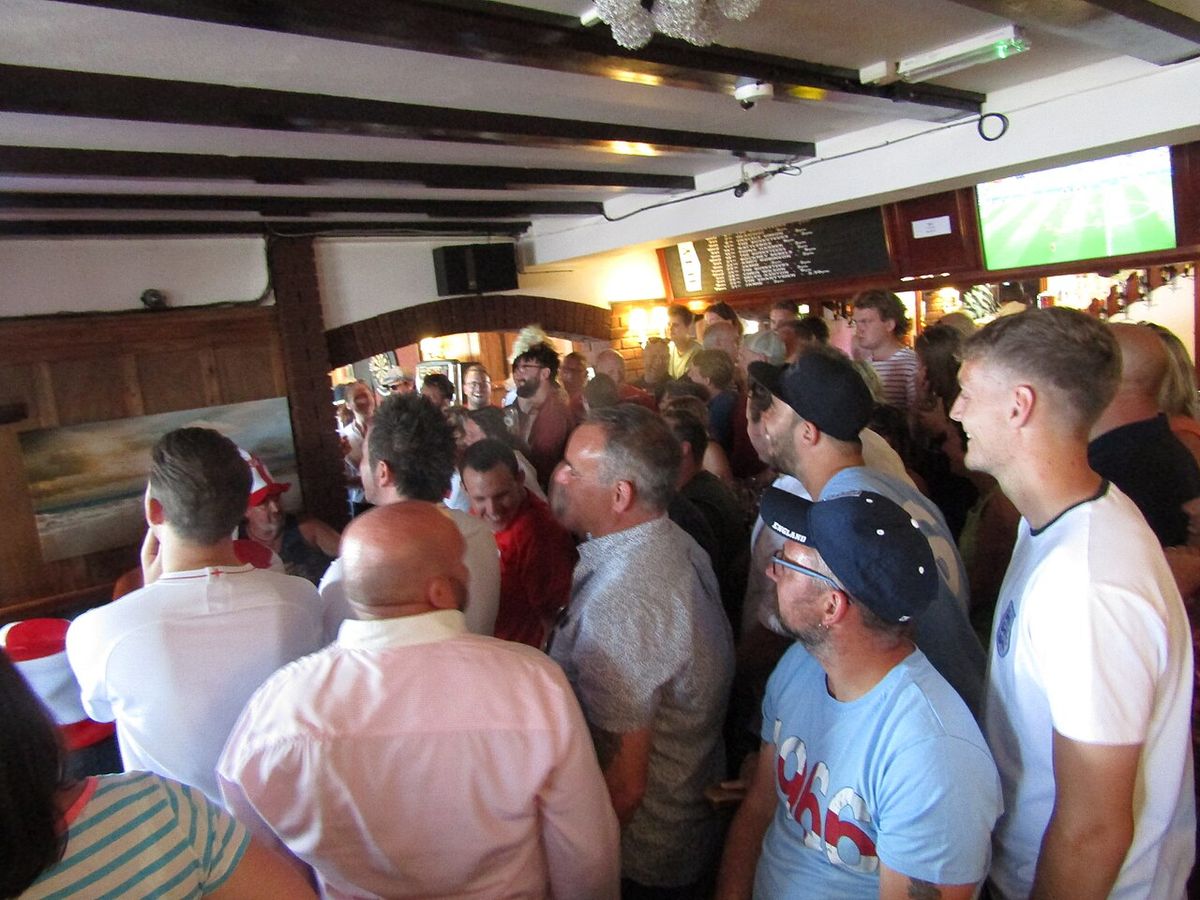
Football Pub Etiquette for People Who Did Not Grow Up With It
The fear is of being quizzed at the door. There is no quiz. There are about five real rules, and only one of them gets anybody annoyed with you.
FirstMove Team
30 July 2026 · 7 min read
The fear, if you did not grow up with this, is of a quiz. That someone will turn round, clock you, and ask a question you cannot answer.
There is no quiz. In eleven years of Saturdays nobody has ever been asked to prove anything at the door of a pub, because the pub's entire commercial interest is in more people being in it. What actually exists is a short list of unwritten rules, most of which are about spatial awareness rather than football, and one of which genuinely matters.
Here is the whole list, before the season starts on 21 August.
The one rule that gets people annoyed with you
Do not stand in front of the screen.
That is it. That is the sin. Forty people have arranged their entire afternoon around a sightline, and walking into it while holding a drink is the one thing that will get you spoken to sharply by a stranger.
The practical version: when you move through the room, look at where people's faces are pointed and walk behind them. When you stop, stop somewhere that is behind somebody rather than in front of them. Everything else on this list is a nicety. This one is load-bearing.
The four that are just good manners
Do not sit in a claimed seat. A coat over a chair, a half-finished pint, a folded paper, a stool at the bar with nothing on it but a regular standing two feet away having a conversation. All claimed. If you are not sure, ask. "Is anyone sitting here" is a normal sentence and nobody has ever been offended by it.
Understand rounds before you get caught in one. If you fall in with a group and somebody buys you a drink, you are now in a round, and the expectation is that you buy the next one for everybody who is in it. This is not a trap, it is the mechanism by which strangers become acquainted, but it is worth knowing that it has a rhythm and that skipping your turn is the thing people quietly notice. If you cannot afford it or do not want another, say so early and plainly. Nobody minds. People mind being quietly short-changed.
Match the volume of the room. Loud rooms are permission. Quiet rooms are not. If a pub has fourteen people in it watching a Monday night game in near silence, do not be the one narrating.
Do not ask questions during a passage of play. More on this below, because it is the single most useful piece of timing in the building.
What you are allowed to not know
Almost everything, as it turns out.
You do not need to know the offside rule. You do not need to know who is playing, what the table looks like, or why everyone hates the referee this month. You will meet lifelong supporters who could not name their club's third-choice goalkeeper.
Better than that, admitting it is an asset rather than a liability. "I have no idea what is going on, who is the one everybody is annoyed with" is one of the strongest opening lines available to you, for a reason worth understanding: explaining football is a hobby. You are not imposing on somebody by asking. You are giving them the thing they came for and cannot get from their mates, who already know.
If you have been putting this off because you thought competence was the entry requirement, the opposite is closer to true. The fear is a forecasting error, the same one that makes people leave good conversations convinced they were being tolerated, which psychologists call the liking gap. Your read on how you are landing in that room is the least reliable information you have.
Timing is the whole skill
The match has a rhythm, and where you place a sentence inside it matters more than what the sentence is.
During play, say nothing that needs an answer. A groan, a wince, "oh, come on" in the general direction of another human being. These are complete social acts and they require nothing back.
At half time, talk. Fifteen minutes, volume down, everybody stretching and queuing. This is the window, and it is the only one. If you speak properly to one person all afternoon, speak to them here.
At full time, ask the one question that matters. Not for a number. Ask whether they are in for the next one. It is a lower bar, it is easier to say, and it proposes the thing that actually builds friendships, which is turning up again rather than following up perfectly.
Choosing the right room for a first go
Not all football pubs are the same difficulty setting.
A big multi-screen pub is the forgiving option. Mixed crowd, several matches on, nobody's identity riding on the result, and enough churn that a new face is unremarkable.
A supporters' pub is the harder first outing, and the better second one. The emotional stakes are higher and the room is more tightly bonded, which is exactly what makes it valuable once you have a team, and slightly daunting when you do not. If you have moved cities and do have a club, that room is the fastest social shortcut available to you, and we have written about how to find it.
Daytime kick-offs are gentler than night ones. Less drink, more families, more conversation.
Women's football screenings are the easiest entry point in the game right now. The crowds tend to be mixed, newer, and considerably less invested in policing who belongs, largely because most of the room arrived recently too.
If you are going to be the only woman in the room
Worth addressing directly rather than pretending the question does not come up.
It varies enormously by pub, and the variable is the pub rather than football. A large mixed-crowd place at 3pm on a Saturday is an ordinary public space. A small single-club pub for a night game is a more specific room, and you are entitled to decide you do not fancy it without that being a failure of nerve.
The practical version: go in daylight, go somewhere big for the first one, stand at the bar rather than in a corner, and treat the staff as your allies, because they are and it is their job to be. None of that is unique to football. It is the same calculation people make about any unfamiliar room, and the reason we argue that social confidence is a skill rather than a trait is that the calculation gets faster with practice.
Where FirstMove helps
Two things, both practical.
Finding a room in the first place, which is harder than it sounds if you do not already know which pubs show what. The app runs a live feed of what is on near you, filtered by tonight, by walking distance and by the kind of thing you are after.
Then the approach itself, once you are inside. A VibeZone is a geofenced social space tied to that one pub, live only while you are there. The 3-Way Handshake means you Knock to signal you are open to company, the Challenge confirms it is mutual, and only then do you Connect. Nothing opens unless both people have said yes, which removes the exact thing that keeps first-timers standing quietly near the fruit machine: the risk of being the one who misread the room.
Opening weekend
Friday 21 August, Arsenal against Coventry at 8pm, then a full weekend of fixtures through to the Monday night.
Pick a big pub. Get there twenty minutes early. Walk behind people, not in front of them. Say nothing clever during play, talk at half time, and ask about the next one before you leave. That is the entire etiquette, and the rest of it is just being in the room.
Download FirstMove and find one near you before the first whistle.